
Pitching is the Orioles’ biggest need, but the front office has been apprehensive about trading big-name prospects. Perhaps there is a way to bridge the gap.
MLB’s trade deadline is rapidly approaching. Teams have a little over a week to evaluate themselves, inspect the market, and then take advantage of their final opportunity this season to make major changes to their roster. The Orioles—with their need of pitching and impressive collection of prospects—are expected to be a major player.
Traditionally, trades at this time of year, go a certain way. A team in contention will put together a package of prospects (and maybe a fringy major leaguer) and send it to a team out of contention in exchange for a bonafide big league upgrade. Players on expiring contracts or those that play a less impactful role, like middle relief, tend to cost less. Whereas everyday position players or starting pitchers with years of control can be expensive.
The Orioles are in a position where they can go this traditional route. They have the big name prospects—Jackson Holliday, Samuel Basallo, and Coby Mayo—that it would take to land one of the big starters on the market (Tarik Skubal, Garrett Crochet). And they certainly have depth within their system to shore up their bullpen a bit. But that doesn’t mean they won’t also go off the beaten path to accomplish their goals.
In a radio interview this past week, Jim Bowden (I know) reported that the Philadelphia Phillies have talked to the Orioles about a trade for Cedric Mullins. That would certainly catch most of the Orioles’ fanbase by surprise.
Bowden does not specify what the return would look like. Mullins does have one more year of team control and is still widely regarded as a top defender and baserunner. But his bat has been bad this year (79 wRC+, .636 OPS). So, his value may not be massive. The Phillies have a terrific bullpen that may have some surplus parts to move in this sort of deal. But the Orioles could just as easily look at it as a way to create space on both the roster and the payroll for other additions. Either way, it would still be odd for one of the league’s top teams to part with their regular centerfielder in-season, even if he is a platoon player at this point.
It should be said that just because the Phillies talked to the Orioles about Mullins does not mean that Mullins is on the trading block at all. This could be more about connecting dots. It is understood that the Orioles would like to add a right-handed centerfield option to play against left-handed starters. But in order to free up that room, Baltimore may need to part with a big league outfielder. Mullins would be the logical choice to move since he is older, left-handed, and seemingly on the downward swing in terms of performance.
While the Mullins rumor could be a big nothing burger, there is potential that other members of the Orioles’ big league roster could be on the move in the coming days.
Mike Elias has been hesitant to trade young talent to this point. If he wants to land a big fish at this deadline, he will have no choice. Selling teams will require high-end youngsters. But it is possible for Elias to plug some of the holes on his roster with lower-ceiling pieces. At the very least, that would allow him to maintain the depth in his system even if he does have to trade away some of his bigger names.
Ramón Urías is a name that jumps off the page in this regard. The infielder is under team control through the 2026 season. He has a Gold Glove in his trophy cabinet at home and possesses a consistent, above-average big league bat that has been heating up (1.143 OPS in July). It’s the sort of profile that could make sense for a contender looking to add a utility option or a rebuilding club that needs a short-term solution somewhere on the infield. In both scenarios, the Orioles would not get a ton in return, but a middle relief option or maybe a back-end starter seems realistic.
That sort of move is relatively easy to swallow if Holliday is actually ready for the second base job. That would push Jorge Mateo into a full-time utility role and allow Jordan Westburg to settle in at his better position, third base.
Kyle Stowers is not a major leaguer as of this writing, but he would be one in a lot of organizations. The Orioles have called him up twice this season, and he owns a .797 OPS in limited action. But it’s tough to see him cracking a long-term role in Baltimore given all of the other young outfielders currently on the active roster, not to mention some of the minor league depth making it’s way up the system. At this point, Stowers is something in between a prospect and a big leaguer, which could be perfect for a rebuilding team looking for instant help.
As would be true with similar fringy big league talents, any return package isn’t going to be massive. But the Orioles are in the enviable spot of not needing to reinvent themselves at the deadline. They already have many of the tentpoles of a World Series winner in-house. Stowers alone seems sufficient for middle relief help.
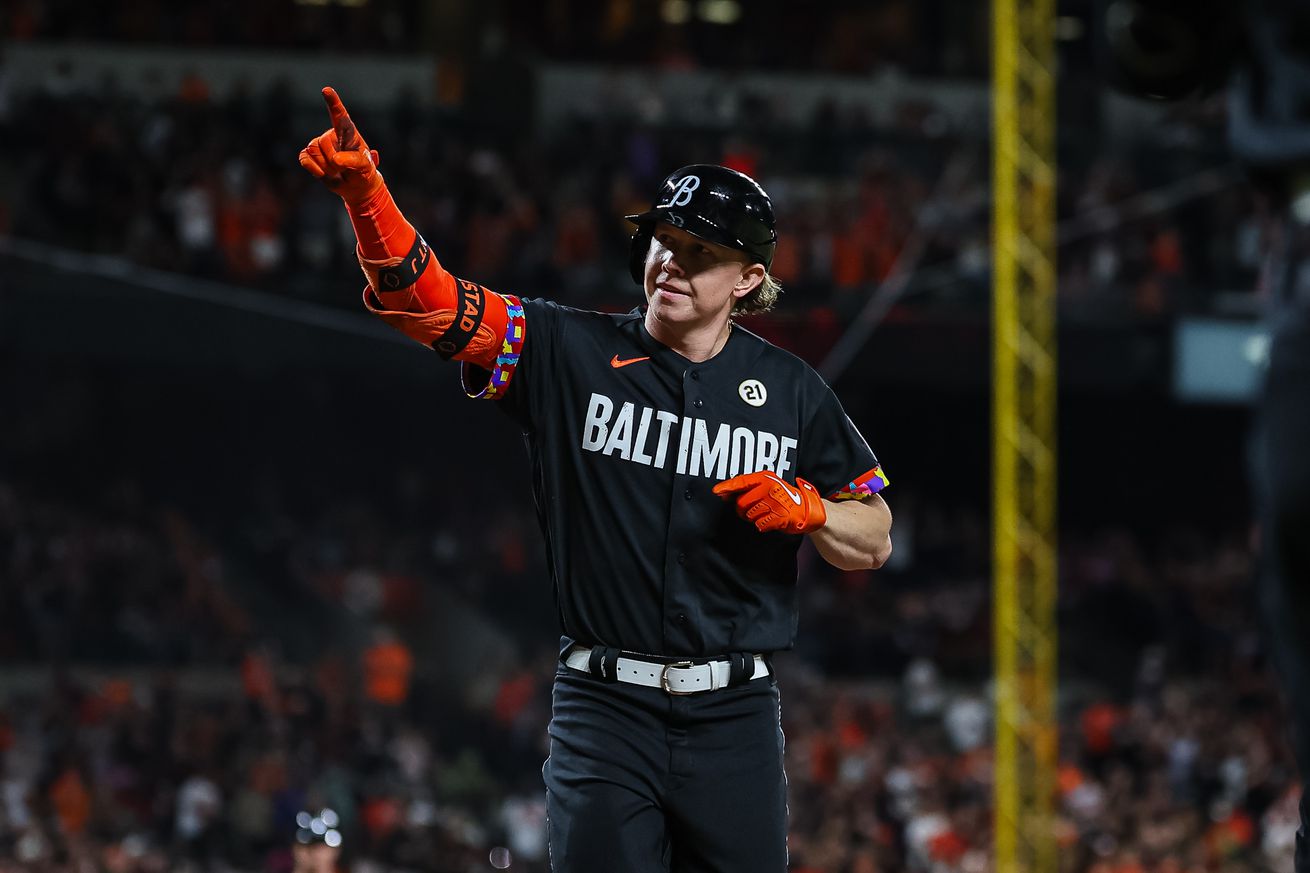
One other name currently in Baltimore that at least seems worth mentioning here is Heston Kjerstad. The former second overall pick has graduated from most prospect lists, but he is still a rookie with oodles of team control. He may not be quite as valuable as Holliday or Mayo, but clubs looking to win in the next two or three years would be ecstatic to get him, depending on the trade.
At this point, Kjerstad is the heir apparent to Anthony Santander in right field. Santander is due to hit free agency this winter, and while the Orioles could ink him to a long-term deal that feels unlikely. Kjerstad has finally carved out a big league role in the last month, and the numbers have been impressive (.296/.406/.500), although his peripherals aren’t quite as good.
At the same time, it’s easy enough to see the dominoes falling to the point that Kjerstad is left looking for playing time rather than mashing homers in the lineup on a daily basis. If Holliday does take the second base job, then the infield is full up. So, where does Coby Mayo play in 2025? Right field has long been theorized as his future home. His right-handed bat sure would help balance the lineup. Kjerstad may have a better bat than Colton Cowser, but Cowser has a sizable advantage in athleticism, speed, and fielding ability. Kjerstad could serve in a roving role that gets him at-bats at first base, DH, and corner outfield, but would that be more valuable than being the centerpiece of a trade to land another ace pitcher? It’s a tough question to answer.
If the Orioles do not want to part with any of Holliday, Mayo, or Basallo, then Kjerstad is essentially a requirement in any sort of significant deal. The team could add to their rotation and hold onto all of those players, but that limits the Orioles to depth additions at the back of the rotation rather than impact arms leading the way. It will also leave them searching for solutions in the offseason as Corbin Burnes takes suitors in free agency and Kyle Bradish recovers from Tommy John surgery well into the 2025 season.
The 2024 Orioles need to improve in the next eight days, which could be slightly at odds with Elias’ long-term view of team-building. Trading away the three players mentioned here could allow him to thread the needle without diving too deep into his prized farm system.